Flamenca's Romance
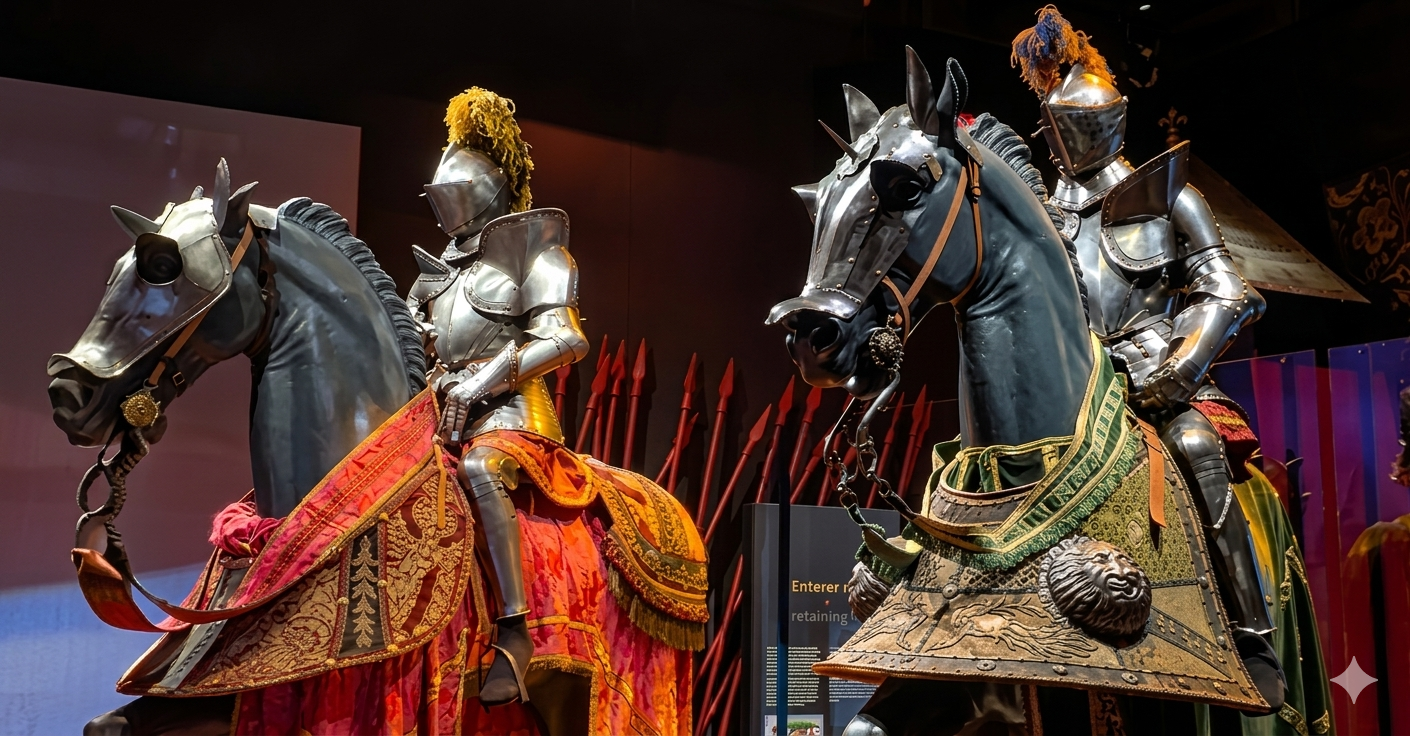
Driven more by a hunger for knowledge than for food, I decided to skip lunch and spend my tight schedule’s precious hour at the museum Pointe-à-Callière in Montreal. A special exposition of knights and armours on loan from the Stibbert Museum in Florence had captured my imagination. I was longing to let my mind travel back to the Middle Ages, an era I pictured as a time of romanticized chivalry for cool men, while women were so often relegated to the role of ornament or landless peasant.
Copyright, © 2020,www.Pomalaza.com
- e-mail
As I entered the quiet hall, I was immediately struck by the silent army of articulated steel. The evolution of the craft was on full display: from early chainmail to full plate armour, each helmet and gauntlet a testament to human ingenuity. I was impressed by the minute details, the carefully jointed fingers, the intimidating visors, and the brilliant, practical solutions for a knight’s most basic needs. How, I wondered, did a man so magnificently armoured can even piss without the help of his squire? They truly had thought of everything.
Then came the weapons: lances, maces, and swords with brutal, honest names like "War Fork" and "Bastard Sword." Hefting one, I was struck by a perverse contradiction, the immense effort to craft something so heavy and cumbersome, its sole purpose to pierce and slam another human being. Yet, I couldn't deny the exquisite workmanship. Even instruments of death were adorned with magnificent, flowery engravings on every plastron, pauldron, halberd, etc.; the artisans were masters without a doubt.
A section allowed visitors to try on replica pieces. Obliviously, without a loyal esquire to assist me, I fumbled with a gauntlet and pauldron, gaining some respect for the weight those fellows bore. This physical burden stood in stark contrast to the idealized moral code displayed on a placard: bravery, loyalty, courtesy, and generosity. It was a noble aspiration, but history suggests it was often just that, an aspiration, frequently violated rather than practiced.
By the end of my visit, with an empty stomach and a mind full of thoughts and ideas, I drifted off into a daydream. I was no longer in a museum but in the twelfth century, a knight galloping a great destrier, ready to charge a dark tower and rescue a Mademoiselle imprisoned by a jealous husband.
Oops! Sorry dear reader, I suppose, this is the inevitable hazard of visiting such an exhibition on an empty stomach combined with my imagination already primed by the pages of the book I read last night: “The Romance of Flamenca”